 Menu
Menu
 Looting 'Ayn Karim by newly arrived persecuted European Jews, 1948
But this is only a portion of the compensation due according to international law. The basic principle of compensation is
to make good as stated clearly in Resolution 194, or in general terms: as far as possible, wipe out all the consequences of the illegal act and
re-establish the situation which would, in all probability, have existed if that act had not been
committed (Quigley, p.209). This is the same
principle {Wiedergutmachung) under which the German Federal Government paid the Jews DM 102 billion for Nazi crimes.
The entitlement to compensation is derived from international law dealing with war crimes and from Resolution 194 which relies on
international law or equity. War crimes are excluded from Resolution 194 (see A/AC.25/W.81/Rev.2/annex ll, p.6) since these
crimes are well-regulated by international law beginning with the World War II trials and concluding now with establishment of the
International Criminal Court under Rome Statute of 1998.
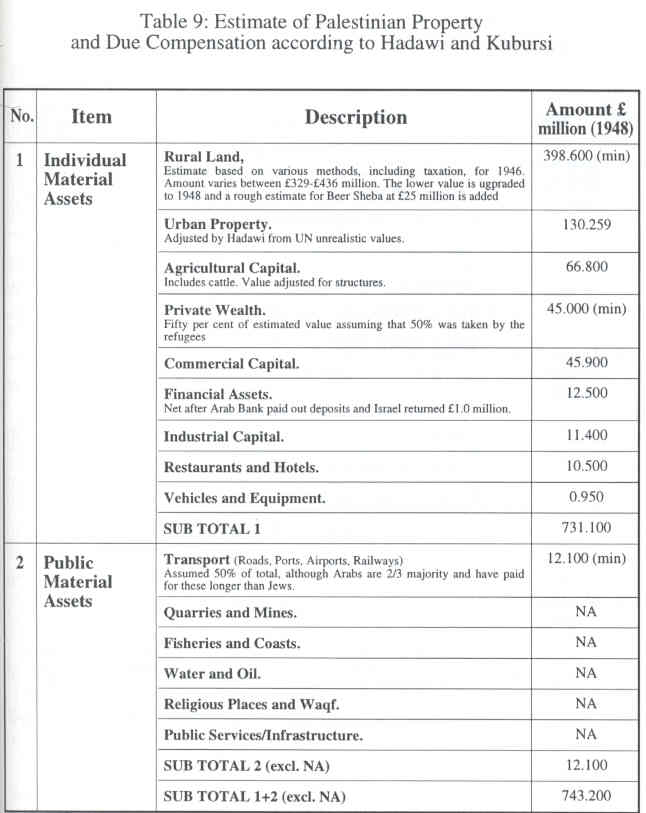
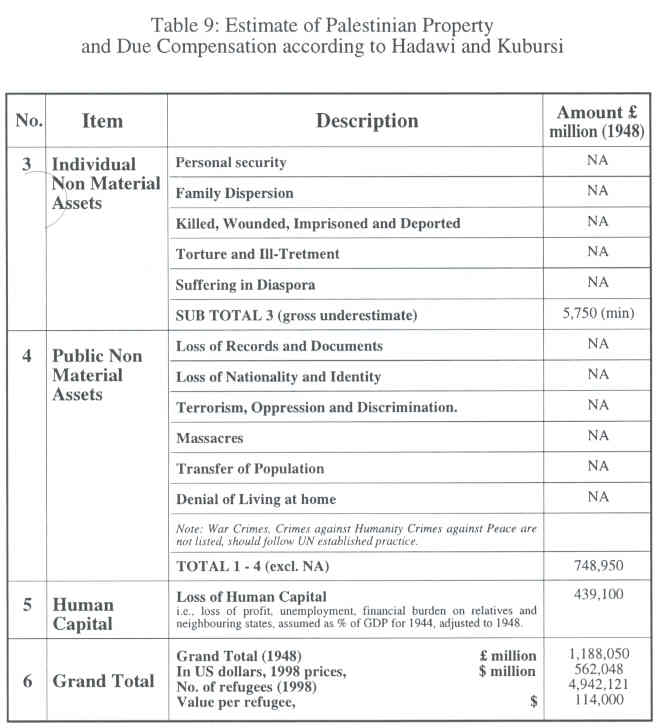
Compensation, other than for war crimes, can be summarized in the following categories (Hadawi and Kubursi, 1988):
- Individual material assets, such as land, property and business.
- Public material assets, such as natural resources and services.
- Individual non-material assets, such as personal and family security.
- Public non-material assets, such as identity, culture, holy places.
Most of the published research was concerned with individual material assets. Table 9 is an attempt, based on Hadawi and
Kubursi, to identify the various components of compensation.
It is to be noted that monetary values estimated in Table 9, if used for compensation, should be reduced by the value of land and homes
which should be restored to their owners, upon exercising the Right of Return.
Homeland is not for sale.
 |
 |


 Over 700 Oral History interviews (including 3,500+ hours of recording) can be viewed online.
Post Your Comment
*It should be NOTED that your email address won't be shared, and all communications between members will be routed via the website's mail server.