 Menu
Menu| Prev | Next | Scroll below for the primary source which is Village Statistics of 1945  |
| Prev | Next |
 Official UN Map: It was updated in August 1950, showing that Palestinians STILL OWN 94% of the lands
 Just Imagine someone sitting in your chair for over seven decades. Again, imagine this person was sitting in your house and eating from your trees! Please tell us how you would feel in the comments section.
Concerning Beersheba, Miri, And Public (a.k.a. State Domain) Land
How Did Wikipedia's Editors Misquote Primary Sources?
What Are Miri Lands And Its Owners' Rights?
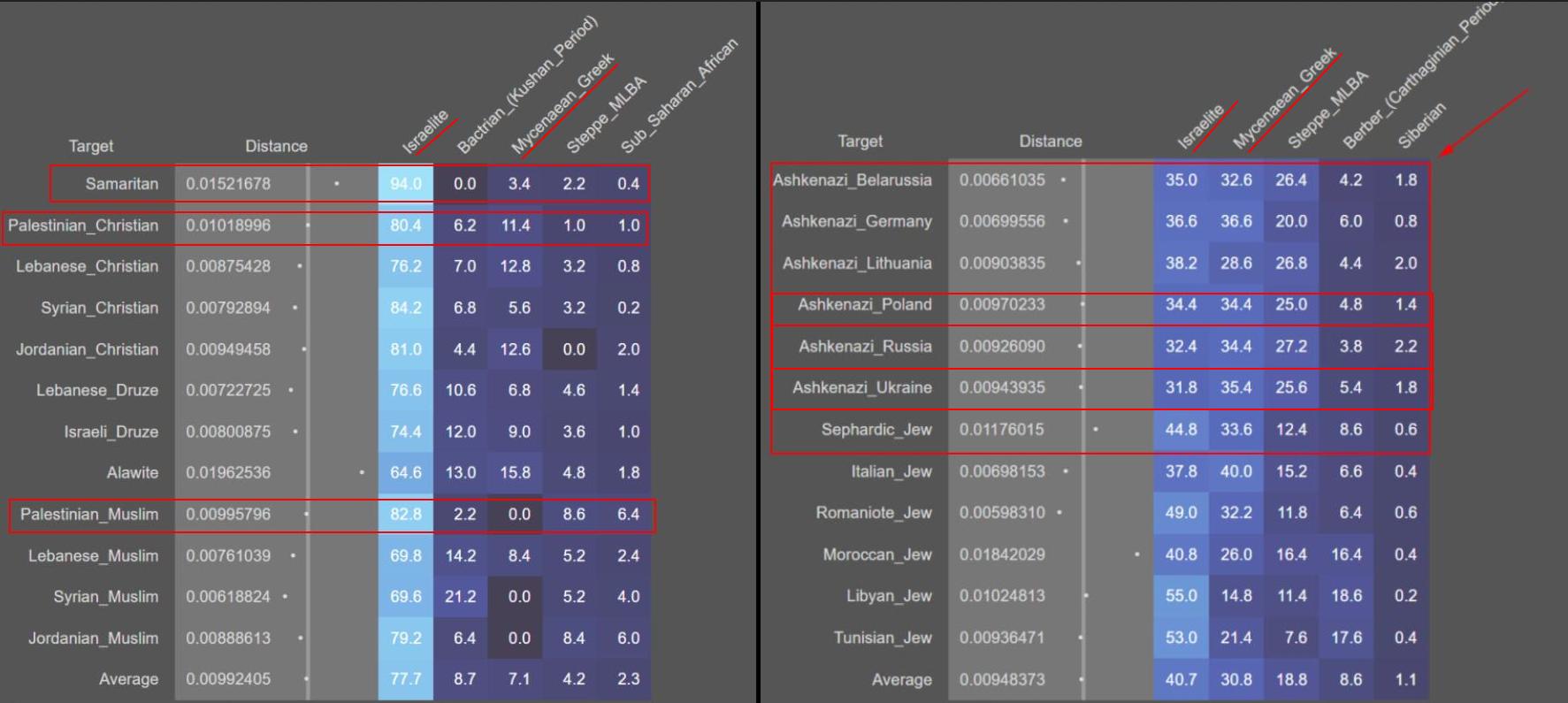 Let's Examine The DNA Genetic Distances between Israelites, European Jews, Arab Jews, and Palestinian
 In layman's terms, miri land, in practice, functions as a privately owned land that has not been deeded yet unless the owner stops using the land for a prolonged period.
Miri lands have the following features and rights: A) The State holds the miri land's title but with no tassarouf right (meaning the state has no right to sell or lease the land) until farzz or land assignment occurs. B) Miri land could be titled (a.k.a. mulk) in the grantee's name for a fee, which was uncommon during the Ottoman rule to avoid military service. This was the primary reason why most of the lands were of the type miri, but all changed after WWI ended, when the British colonized Palestine. Again, as of Nakba, around 17% of the lands were titled. Actually, not for the war; the rate would have been much larger. Don't underestimate this point; Palestinians (like others in the Levant) hated serving in the Ottoman army. C) Miri lands have the right of succession, meaning they could be passed on as inheritance when the grantee dies. D) Miri's land could be used as collateral at a financial institution, like a Bank to take out a loan or a mortgage.
 JFK said it BEST in 1939: Palestine Was Hardly Britain's to Give Away
 In the table below, we have documented the rights of each land type category. As you see below, miri land has most of the rights as private land (a.k.a. mulk), which explains why miri functions in practice as private land. The only difference is that miri lands were not deeded, and the borders of the lands weren't clearly identified. As long as miri lands are being used in a productive manner, the grant stays in force indefinitely. That is why buying and selling miri land was (and still is) problematic to this date, especially in the occupied West Bank and Jordan. This explains why the Land Settlement of Title law was one of the first laws to be enacted by the British Mandate in the early 1920s, which was a necessary step for the Zionist colonization of Palestine. Before WWI, it was very hard to buy big tracts of land:
| Land Type | |||
| Owners' Rights | Private (mulk) | Miri | Lease Land |
| Is time limited? | NO | NO, the Ottoman & British laws clearly stated that miri land resembles an indefinite lease. | YES |
| Could it be leased? | YES | YES | In general, no, unless subleasing was allowed in the contract |
| Could it be terminated by the state? | NO | On rare occasions, the state may cancel the grant if the grantee stops using the land for a prolonged period | In general, no, unless subleasing was allowed in the contract |
| Could be mortgaged? | YES | YES | In general, no, unless that was specified in the contract |
| Could it be sold? | YES | YES | NO |
| Is it registered in tabu? | YES | YES | NO |
| Could it be converted into a private? | Not applicable | YES | NO |
| Could it be inherited? | YES | YES | In general, no, but on rare occasions, that is allowed by landlords |
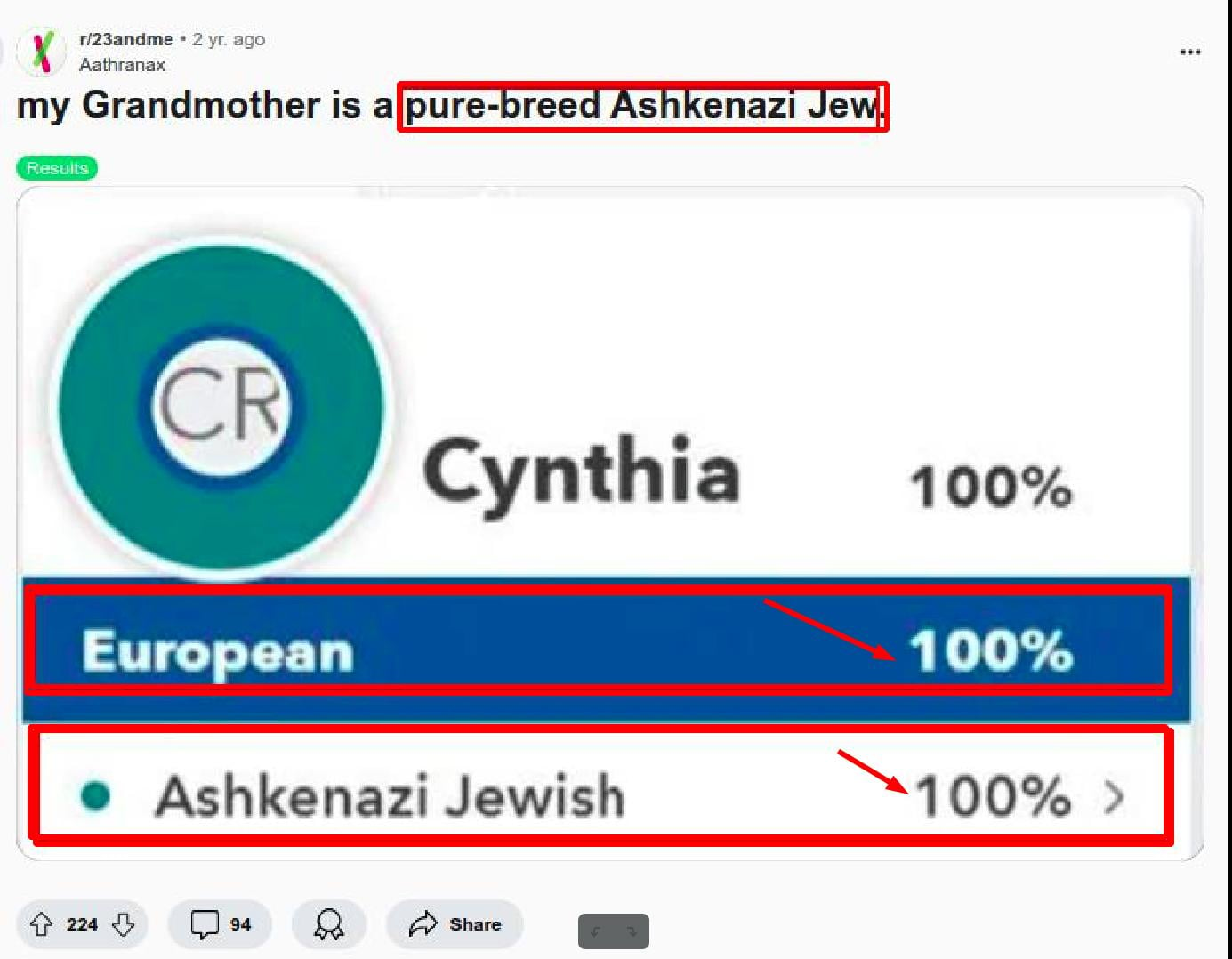 A Playlist Of Jews Sharing Their DNA Test Results
 Shamelessly, often Jews keep insisting that miri lands are state-owned (although Ben-Gurion debunked that myth as we have proven earlier) and comparable to European feudal laws. If that is the case, how can private citizens mortgage or sell miri lands, and the state has no such rights? What kind of a "lease agreement" doesn't impose time limits and give succession rights to the leasee? What kind of a "lease" or feudal agreement gives the leaseee or grantee the right to register the land as a private one? The answer is clear: only the owners of the land who have lived on the land for hundreds of years. On the other hand, we ask: why only a few Jews have miri lands? Again, the answer is clear: Jews are not indigenous to the lands that recently escaped from European persecution, and that explains why only a few of them have land deeds. Anyhow, please pay attention to our collection of land deeds, where many were initially miri lands when they came under the land settlement law. Therefore, if miri lands (which comprised the vast majority of state-held lands) were State-owned with full tassarouf right (a.k.a. mulk), how could the British Mandate cede much of its lands this way? Why were such lands not ceded to Zionist Jews? The answer is simple: the government deeded the lands to those who owned them, and those were Palestinians.
 Indian Lands For Sale: Fine Lands In The West For Sale as of 1910. Dirt Cheap Prices won't last. Courtesy of the US Department of the Interior.
 In a nutshell, State domain lands (or public lands) means that the State is just the holding legal entity with no tassarouf right until the land comes under the land settlement of title and all claims are settled; that is how land settlement happens, not just in Palestine but worldwide. Now, if you still have doubts, we ask you to watch this short clip, which summarizes what we have discussed in under three minutes:
Concerning Beersheba
Summary of Land Ownership & By Whom
Here is ownership of land in Palestine broken up by share of Palestinian Arabs (including "other" non-Jews) and Jews as of April 1st, 1943, sourced from the British Mandate's Survey of Palestine, p. 566. It should be noted that "other non-Jews" in the table below refers to human groups such as German Templers and Baha'is; the state wasn't included in such a definition. Such an obvious fact becomes apparent once the primary source of this table (Village Statistics of 1945) is examined which provides granular level details at the village and distict levels. Anyhow, as can be seen below, the state owned very little (limited to roads, rivers, railroads, and lakes), which was confirmed by Ben-Gurion as we outlined earlier (see Jewish Frontier, Oct. 1935 Edition, pages 26-27)

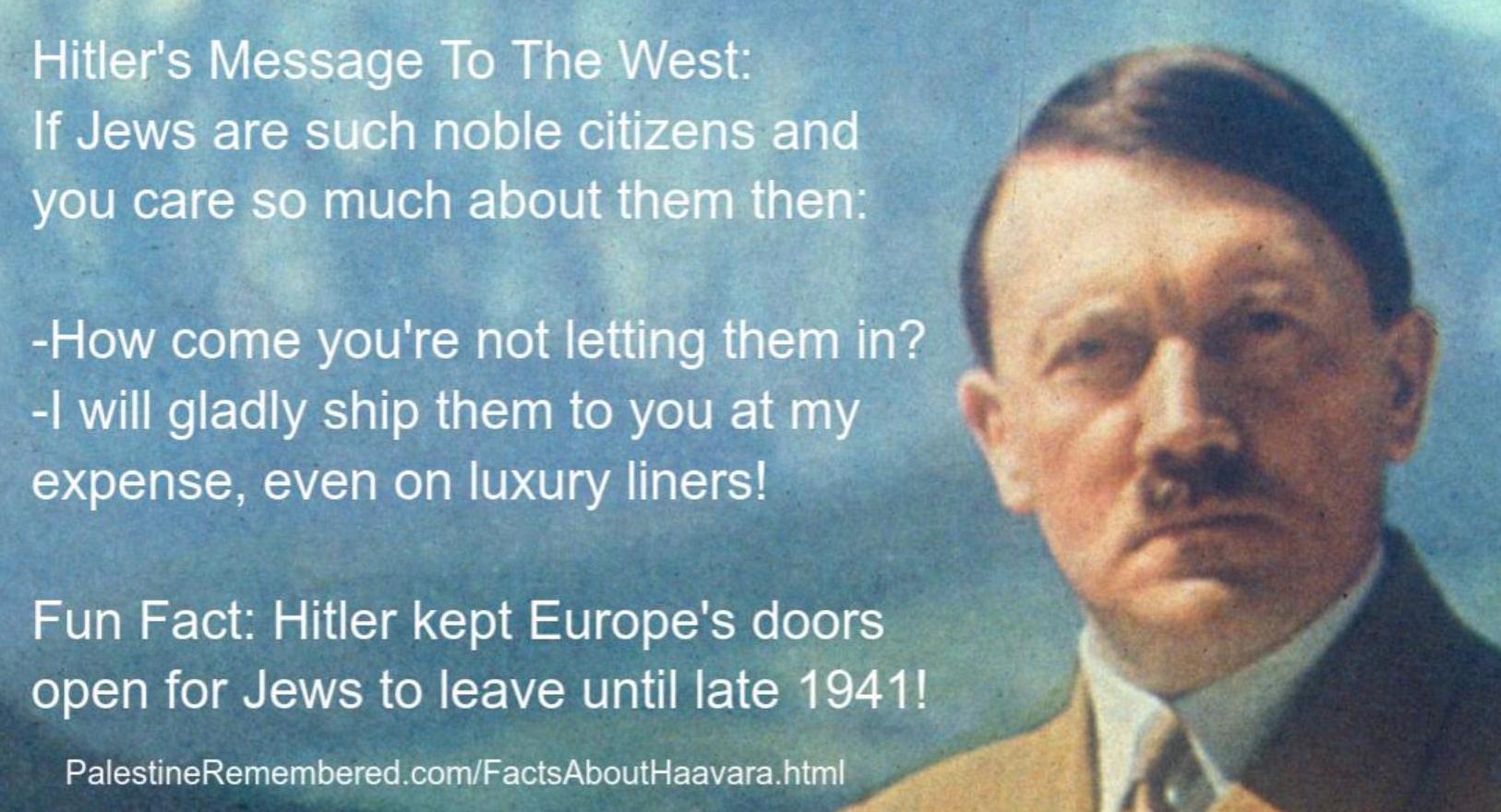 Hitler's Message To The West: If Jews are such noble citizens and you care about them, how come you're not letting them in?
Here is land related land sale and purchase transactions during the critical year of Zionist developments (5th Aliyah) between 1933 and 1939 (Statistical Abstract For Palestine, 1940 by the British Mandate, p. 173). If lands in Palestine were mostly owned by the state, as most Zionists claim, then why did most of the land sale and purchase transactions rarely involve the government? As you see below, most land-related transactions involve who owned the lands: Palestinian Arabs. We hate to keep repeating the fact that it was David Ben-Gurion who asserted similar data when he addressed the 19th Zionist Congress in Oct 1935 (see Jewish Frontier, Oct. 1935 Edition, pages 26-27).

Here is similar data sourced from the Jewish Agency's publication (Statistical Handbook of Jewish Palestine, 1947, p. 134):

Here is David Ben-Gurion addressing the 19th Zionist Congress, clearly stating that the state owns a small percentage of the overall land, and much of the land is in private hands. On page 27, notice how he admitted that half of Beersheba was cultivated, but by whom, dear David? Perhaps the Negev desert bloomed itself, or maybe it was bloomed by those who didn't exist? Feel free to verify our findings at Archive.org. It was cited by the Jewish Frontier, October 1935 Edition, pages 26-27:

And here is land ownership as of 1940 from the British Mandate's Statistical Abstract For Palestine, 1940, (p. 172) as you see, most of the land was purchased from Palestinian Arabs when the Haavara Agreement between the Nazi regime and the Zionist movement was active in the 1930s:

Just in case we failed to convince you of the Palestinian case, we urge you to watch this American Indian articulation of the Palestinians' point of view in under 30 seconds:
Or watch Karma Nabulsi nailing it to Dani Dayan in under 120 seconds:
Can someone make a meme like this one but for Bibi? Don't forget to add pedafiles and rapist to the list.


 Over 700 Oral History interviews (including 3,500+ hours of recording) can be viewed online.
Post Your Comment
*It should be NOTED that your email address won't be shared, and all communications between members will be routed via the website's mail server.