 Menu
Menu

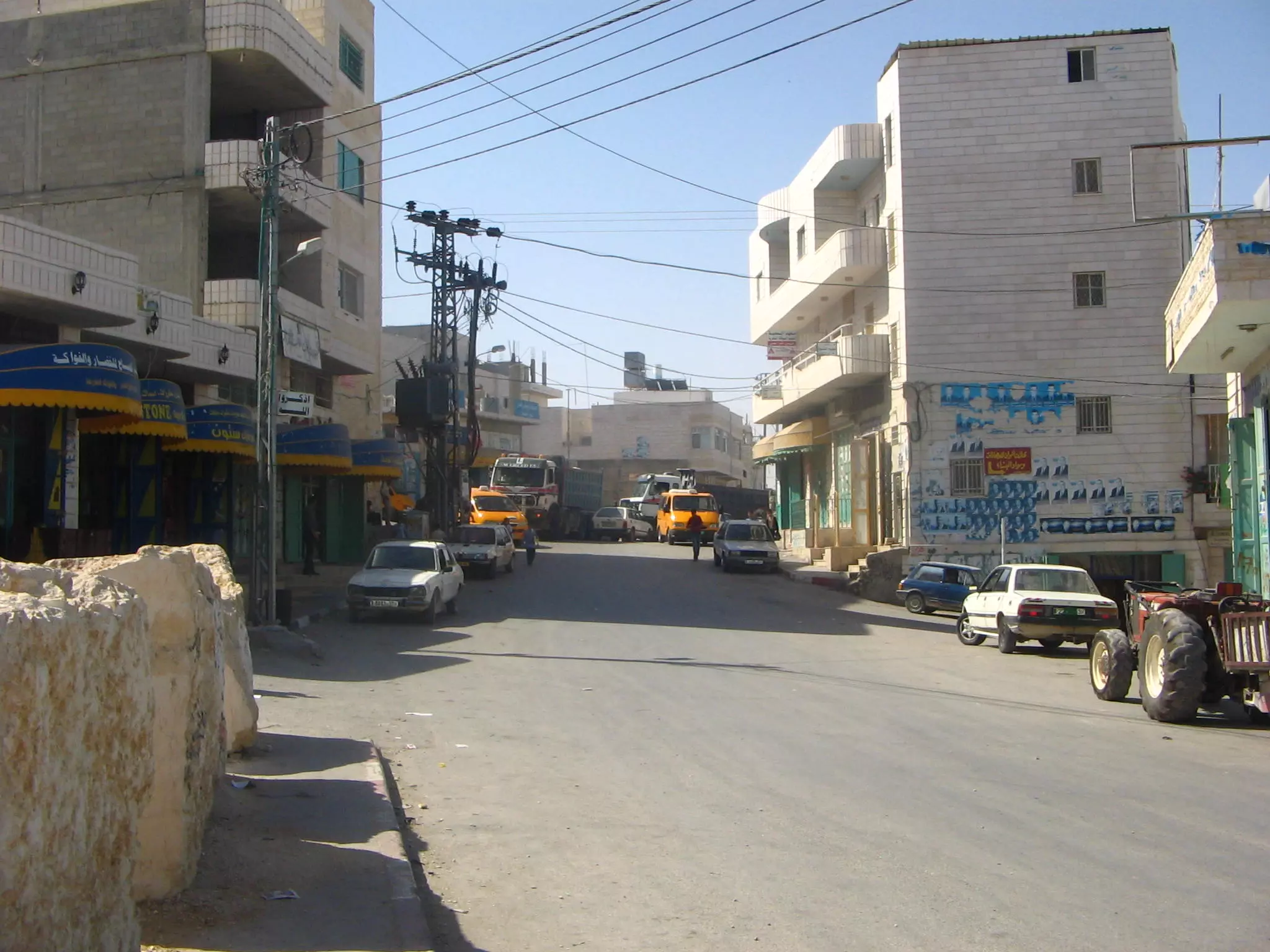 Click Image For Town Details
Beit Fajjar (Arabic: بيت فجّار) is a Palestinian town located eight kilometers south of Bethlehem in the Bethlehem Governorate, in the central West Bank. According to the Palestinian Central Bureau of Statistics, the town had a population of over 10,900 in mid-year 2006.[1] The town's primary economic sectors are agriculture and stone-cutting; the town has 52 stone-cutting factories.[2]
Beit Fajjar is believed to have been a camping area for the Islamic Caliph, Umar ibn al-Khattab. Beit Fajjar was mostly farmland until the 1700s, when it gradually transformed into an urban settlement. The site's high altitude was the highest point in the area and later the town expanded into other hills. During British rule in Palestine during the 1920s-40s, Beit Fajjar was used as an observation point.[2]
[Source: http://www.bethlehem.ps/cultural_sites/agricultural_villages/fajjar.php]
Beit Fajjar
Beit Fajjar which lies 14 kilometres southwest of Bethlehem, is a town of about 12, 000, best known for its 52 stone-cutting factories. It is believed that Caliph Omar Ibn Al-Khattab camped in the village, which dates back to Canannite times, on his pilgrimage to Jerusalem in 638 AD. Primarily farmland until 300 years ago, it later developed as a small urban settlement on the top of the highest hill in the area and gradually spread to the hills around it. Affording a view of the surrounding area, its old core used to be an observation point in British times. The Centre for Cultural Heritage Preservation has implemented an urban rehabilitation project of part of the old core including putting in new infrastructure such as electricity, sewerage, and water, cleaning facades and adding railings. It has also rehabilitated a hosh ؟extended family house- which had been abandoned for years and was believed to be inhabited by jinn and was in the process of turning into a khirbeh, one of the everyday archaeological sites in Palestinian life. The contrast between before and after is instructive of the place of old buildings in village life. Now the hosh serves as a center for the village؟s very active women؟s group, who use it for meetings and courses leading to a high school degree for women who married before receiving it. It will also have a library, a center for social work, and a kitchen for the women to make preserved goods to sell at festivals. All of the activities are done on a voluntary basis. Not far from the women؟s center is a tabboun oven, so if you visit the village, you might be able to buy some fresh bread, straight out of the oven.


 Over 700 Oral History interviews (including 3,500+ hours of recording) can be viewed online.
Post Your Comment
*It should be NOTED that your email address won't be shared, and all communications between members will be routed via the website's mail server.
BEST TO ALL ACTIVE PARTICIPANTS WAEL, NAEL , MOHAMMAD AND THE LIST GOES ON.
DR. MOHAMMAD